reabc/A Letter to a Young Gangster - Uhuru Baraka Rowe/A Letter to a Young Gangster - Uhuru Baraka Rowe.pdf
Web PDF • Imposed PDF• Raw TXT (OCR)
![[What follows in an actual letter I wrote to a young brother during the month of Black August 2017 at Sussex II State Prison after a conversation we had about the Black Libera- tion Movement. It was during the course of this conversation that the young brother re- lated to me that, even though he was affilia- ted with the Hoover Crim gang, he considered himself to be a revolutionary. He had such a positive reaction to this follow-up letter that T decided to turn it into an essay with the hope that other gang bangin’ youth will be positively impacted by it as he was. This is an updated version of the original letter of the same title that was posted on my blog at https://consciousprisoner.wordpréss.com and published in The Black Rider and San Francisco Bay View newspapers]. Peace young brother, I hope this letter finds you strong and courageously defiant in mind, body, and spirit. I really enjoyed the few times we’ve exchanged ideas about the new Black Liberation: Movement. I was a little surprised when you told me that you consider yourself to be a Black Revolu- tionary because most young brothers who gang bang don’t identify themselves as such and -1-](A Letter to a Young Gangster - Uhuru Baraka Rowe 2.png)

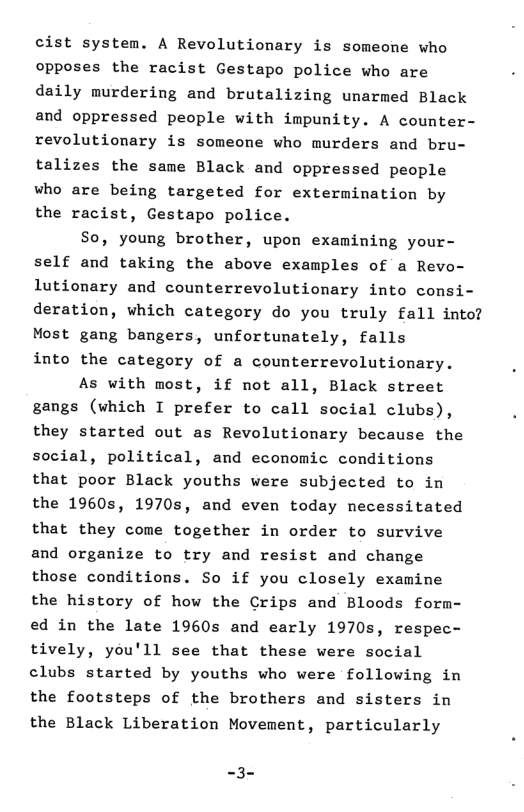





A LETTER TO A YOUNG GANGSTER
By Uhuru Baraka Rowe
1
W
0
Updated March 14, 2019
[What follows in an actual letter I wrote to
a young brother during the month of Black
August 2017 at Sussex II State Prison after
a conversation we had about the Black Libera-
tion Movement. It was during the course of
this conversation that the young brother re-
lated to me that, even though he was affilia-
ted with the Hoover Crim gang, he considered
himself to be a revolutionary. He had such a
positive reaction to this follow-up letter
that T decided to turn it into an essay with
the hope that other gang bangin' youth will
be positively impacted by it as he was. This
is an updated version of the original letter
of the same title that was posted on my blog
at https://consciousprisoner.wordpréss.com
and published in The Black Rider and San
Francisco Bay View newspapers].
Peace young brother,
I hope this letter finds you strong and
courageously defiant in mind, body, and spirit.
I really enjoyed the few times we've exchanged
ideas about the new Black Liberation: Movement.
I was a little surprised when you told me that
you consider yourself to be a Black Revolu-
tionary because most young brothers who gang
bang don't identify themselves as such and
-1-
that is because being one requires opposing
and resisting racism and other systems of
oppression which is a huge burden and respon-
sibility. Others simply don't understand the
concept of a Revolutionary.
simply put, a Revolutionary is someone
who fights and struggles to change the condi-
tions of oppressed people. A counterrevolu-
tionary, on the other hand, is someone who
-- consciously or unconsciously -- fights and
struggles against change so as to exacerbate
and perpetuate the conditions of oppressed
people. A Revolutionary is someone who strives
to transform the criminal mentality into a
Revolutionary mentality. A counterrevolutionary
is someone who values, maintains, glorifies,
and takes pride in the criminal mentality. A
Revolutionary seeks to become a part of the
solution to what's plaguing Black and oppres-
sed communities. A counterrevolutionary seeks
to remain a part of the problems that's
plaguing Black and oppressed communities. A
Revolutionary is someone who utilizes all of
his/her strength, time, and emergy on trying
to liberate Black and oppressed people. A
counterrevolutionary is someone who utilizes
all of his/her strength, time, and energy on
trying to oppress and exploit those already
victimized by the capitalist, white suprema-
cist system. A Revolutionary is someone who
opposes the racist Gestapo police who are
daily murdering and brutalizing unarmed Black
and oppressed people with impunity. A counter-
revolutionary is someone who murders and bru-
talizes the same Black and oppressed people
who are being targeted for extermimation by
the racist, Gestapo police.
So, young brother, upon examining your-
self and taking the above examples of a Revo-
lutionary and counterrevolutionary into consi-
deration, which category do you truly fall into?
Most gang bangers, unfortunately, falls
into the category of a counterrevolutionary.
As with most, if not all, Black street
gangs (which I prefer to call social clubs),
they started out as Revolutionary because the
social, political, and economic conditions
that poor Black youths were subjected to in
the 1960s, 1970s, and even today necessitated
that they come together in order to survive
and organize to try and resist and change
those conditions. So if you closely examine
the history of how the Crips and Bloods form-
ed in the late 1960s and early 1970s, respec-
tively, you'll see that these were social
clubs started by youths who were following in
the footsteps of the brothers and sisters in
the Black Liberation Movement, particularly
those in the Black Panther Party. That is,
until former FBI Director J. Edgar Hoover's
clandestine counterintelligence program /%
(Cointelpro) =- which was designed to "expose,
disrupt, misdirect, discredit, and otherwise
neutralize" the Black Liberation Movement --
came to focus almost exclusively on destroy-
ing the BPP. Hoover's Cointelpro single-hand-
edly assassinated and imprisoned most of the
leadership of the BPP and then destroyed the
Party. Predictably, this void in Revolution-
ary leadership created by Cointelpro left
these social clubs without Revolutionary guid-
ance or influence. Thus began the gradual
shift in these social clubs moving from a
Revolutionary to a counterrevolutionary di-
rection.
Fast-forward to the mid-1980s when the
Central Intelligence Agency (CIA), with the
complicity of the Reagan Administration, be-
gan pumping crack cocaine into poor black
neighborhoods in Los Angeles and beyond. This
was done by the CIA to achieve two goals: to
finance its illegal counterrevolutionary war
against the democratically-elected Sandanista
government in Nicaragua and to severely weak-
en impoverished Black communities so they'll
be more susceptible to subjugation and geno-
cide. Almost overnight, due to the lack of
Revolutionary leadership that had been killed
off and imprisoned by Cointelpro and the gover-
ment-created scourge of crack cocaine, these
social clubs and the ‘oppressed communities in
which they existed became fractured, divided,
‘and hardened counterrevolutionary elements.
They lost sight of their original purpose and
began to prey on the very neighborhoods they
orginally organized to defend, protect, and
liberate. So the question then becomes, how
can these social clubs get back to moving in
a Revolutionary direction?
One of the best examples of a counter-
revolutionary social club regaining its rev-
olutionary footing as a result of a radical
transformation in the consciousness of its
leadership is the 5,000 strong Slauson "gang"
under the leadership of Alprentice "Bunchy"
Carter. The August 1965 Watts riots, which
were sparked by the harassment of a Black mo-
torist by a white police officer, did much
to build a Revolutionary consciousness among
the black youth, especially among members of
social clubs like the Farmers, Gladiators,
Businessmen, Avenues, Vineyard, and other so-
cial clubs existing in Los Angeles at the time
like the Remegades -- Bunchy's clique. So
Bunchy, being the charismatic leader that he
-5-
was, seized the time and succedsfully united
all of these social clubs undef his gemeral-
ship. According to Elder Freemdn, a leader in
the Farmers and who became a close comrade of
Bunchy's later on, this was thg first and only
time in history that there wasfonly one uni-
fied social club in Los Angeled. Later in1%7,
when Bunchy was incarcerated aj Soledad prison,
he was part of a study group that included
Eldridge Cleaver (who later bedame the Minister
of Information for the BPP when he was released
the same year) and George Lestér Jackson (who
was one of the principle foundgrs of the Black
Liberation Movement -~ and the|Black Guerilla
Family in particular -- behind(the walls of
California's notoriously racis prisons and
who later founded the BPP's first prison chapter
in 1970). As a result of his pirticipation in
the study group, Bunchy becamepoliticized
and when he came home, he changed the direction
of his social club by redirecting its focus
on resisting police brutality gnd building
Black unity in order to end th*_ senseless vio-
lence in their communities. |
To build off of that succéss and momentum,
Bunchy along with John and Eri“ ka Huggins
spearheaded the formation of the Los Angeles
chapter of the BPP in 1968 which recruited
heavily from the ranks of the §lausons.Because
|
Bunchy was sucl
leader who ins
lumpen Black y
Black Panthers
his BPP comrad,
Cointelpro-cre
Los Angeles BP
nationalist Uni
oy January 17,
Following
| a respected and charismatic
ired a large portion of oppressed
lith in Los Angeles to become
|J. Edgar Hoover had him and
| John Huggins killed during a
ted beef between members of his
|and Ron Karenga's cultural
ed Slaves (US) organization
1969.
fin the footsteps of Bunchy was
another brother[[by the name of Wolverine Shakur
(aka General T.
a long process
+C.0.). He and other former
f catechization in a Youth
Bloods and’ con‘ came together in unity after
Training School
(a prison for gang-affiliated
youth) in Wattslland founded the Black Riders
Liberation Party (BRLP), also known as the
New Generation
Defense in 1996}
these youths red
their criminal
lack Panther Party for Self-
Like Bunchy and his comrades,
ognized the need to transform
entality into a Black Revolu-
tionary mentality and to unite and channel
their righteous|lindignation towards resisting
police brutality and improving the conditions
in their respective Black communities as a
whole.
In a nutshell, the BRLP serves as a po-
litical vehicle [to end semseless Black-on-Black
violence; build |Revolutionary (bulletproof)
Black Love and Unity; serve the needs of people
in Black and other oppressed communities; or-
ganize against white supremacy, capitalist
oppression, and police brutality; and resurrect
the spirit of the Black Liberation Movement
in the hearts and minds of lumpen and current/
former gang bangin' youth.
I want to emphasize to you, young brother,
that the BRLP was founded by FORMER Bloods
and Crips because the propaganda arm of the
Los Angeles police department and the FBI has
labeled the BRLP as a criminal street gang in
an effort to vilify them in the eyes of the
public, alienate them from the Black and oppres-
sed communities in which they seek to serve,,
and criminalize their Revolutionary political
activity in order to justify the continued
harassment, imprisonment, and assassination of
its members at the hands of law enforcement
officials.
As I said before, these same tactics were
used against the original BPP founded by Huey
P. Newton, Bobby Seale, Elbert "Big Man" Howard,
and Richard and Sherwin Forte in West Oakland
in 1966 in order to disrupt and discredit their
political activity. That a bunch of poor Black
gang bangin' youth were able to tramsform their
criminal mentality into a Revolutionary men-
tality by the taking the initiative to educate
-8-
themselves behind the walls of a neo-slave
plantation,: and.then wniting and founding an
organization in the spirit’and 1ikeness of ohe
of the most Revolutionary Black organizations
to ever exist in settler amerikkka, makes the
racist power structure extremely uncomfortable
and predictably invites the most hostile and
brutal kind of repression that the BRLP has
experienced since its inception in 1996. And
it is this kind of response from the state
which evinces that the strategies and tactics
of a Revolutionay organization are truly
effective. As a wise man once said, "if the
enemy isn't doing anything against you, you
ain't doind nothing." And that is because power
will alvays respond tolegitimate threats to its
existence.
The sisters and brothers of the BRLP are
some of the most committed and discipline
Revolutionaries~of ‘our generation, the kind of
Revolutionaries that the Crips and Bloods “and
virtually every social club that formed in the
oppressed and marginalized ghettos of amerikkka
during the tumultuous '60s and '70s were ori-
ginally intended to be. Now, whether the social
clubs of today can and will transition from
counterrevolutionary to Revolutionary depends
upon the willingness of their leadership to
develop, train, and organize their membership
on a militant and political platform that is rooted in
an anti-racist, anti-sexist, anti-capitalist,
and anti-imperialist framework. And, of course
young brother, Revolutionary transformation
also begins with you. As sister Tone Cade
Bambara once said, "revolution begins with the
self, in the self."
Black Power! .
All Power to the People!
A Brief History of .the Formation
of the Black Riders Liberation Party
Following the Revolutionary example of
the original street gangs of Los Angeles, such
as Boot Hill, Vineyard, Farmers, Businessmen,
Gladiators, Renegades, etc., who came together
in unity in 1964 and consolidated power under
Alprentice "Bunchy" Carter's leadership in
the Slauson gang -- and later in the Los Ange-
les chapter of the Black Panther Party in
1968 -- former Bloods and Crips came together
in unity in 1996 while.at ‘a California YIS
(Youth Training School), a youth gang prison,
and founded the Black Riders Liberation Party,
a New Generation Black Panther for Self-Defense,
under the leadership of General T.A.C.0. (Taking
=10+
All Capitalists Out), a/k/a Wolverine Shakur.
This Black unity resulted from brothers and
sisters (while in the belly of the beast)
reading, studying, and learning about. their
history of how Bloods (Black Liberation Of
Our Descent or Brothers Leading Others Out of
Destruction) and Crips.(Class Revolution In
Progress -or. Community Revolutionaries In Pro-
gress) were, originally created as-up and coming
soldiers of the Black Liberation Movement.:
They learned of how the racist. power
structure had been murdering and:exploiting
Black people since. the .days of chattel slavery.
So they decided to stop committing Black on
Black genocidal violence and unite:.against
white supremacy, police brutality,-and capi-
talist oppression.
They, formulated a basic 13-point: Black
Commune Program (which.is an.updated version
of the orginal Black Panther Party's 10-point
Platform and Program) while at the YTS, calling
for;many points as the original 10-point Plat-
form and Program, and.some:new.updated points,
such as demanding proper medical care for AIDS
victims and.an immediate end to white capita-
lists ‘smuggling crack cogaine and other.drugs
into .the Black communmities.’'s
These brothers-and.sisters -were eventually
-11-
!
released back to the streets of Watts, Comp-
ton, and South Central (once chlled the Red
Zone in the '60s and '70s becaise of the high
incidents of pig brutality aga;ns: Black
people and where most of the original Black
Panthers were assassinated) angl took action.
Their first step was to deal with one of the
most injurious systems of oppression against
Black people: the harassment, brutalization,
and murder of Black people by Facist pigs.
Since its formation in 1996, the BRLP
has built chapters all across émerikkka,
in cities like Oakland, Chicago, Detroit,
and in other states like Georgia, Texas,
New York and South Carolina. The BRLP has also
organized a powerful nationwidé prison chapter,
vith a branch of the Prison Chapter founded
in Virginia in 2015.
The BRLP, under the 1eadu‘smp of General
TAC, in the New Generation Blagk Panther
Party for Self-Defense, and we, {canside: our-
selves to be faster, stronger, [smarter, and
upgraded. Because the Black may and Black
woman, once properly politically educated,
culturally inspired, and physiqauy trained,
is the greatest human fighting ,machxne the
world has ever known. |
-12r,
BLleK Zivks
South Chicago ABC
Zine Distro
P.O. Box 721
Homewood, IL 60430